

Road or mountain cleats: what’s the difference?
Choosing bike pedals can seem complicated. Between clipless pedals with road or mountain cleats, flat pedals, and magnetic systems, each option has very different characteristics.
The best choice depends on your type of riding, your experience, and how much retention you want. Here are the main differences to help you choose the system that suits you best.
Clipless pedals
Clipless pedals use a cleat attached under the shoe. The cleat engages with a mechanism built into the pedal to hold your foot in place.
This system offers several advantages:
- a more consistent foot position;
- excellent stability at high cadence;
- better retention in rough sections;
- a direct connection with the bike;
- less risk of your foot slipping off the pedal.
To release your foot, you usually have to twist your heel outward. This movement takes a short learning period, but quickly becomes natural with a bit of practice.
There are two main categories of clipless pedals: road pedals and mountain bike pedals. Each uses a different type of cleat that’s compatible with its own engagement mechanism.
Road cleats
Road cleats are wide and generally made of plastic. They’re usually attached under the shoe with three bolts.
The best‑known systems are Shimano SPD‑SL and LOOK Kéo.
Road cleats offer:
- a large contact surface with the pedal;
- a stable platform;
- good pressure distribution under the foot;
- a precise pedaling feel;
- different levels of angular float depending on the model.
Angular float, also called float, refers to the slight rotational movement allowed by the foot when clipped in. More float can promote a natural position and improve knee comfort.
However, because road cleats protrude from the sole, they make walking feel less natural. They’re also exposed to contact with the ground and can wear out more quickly.
Cleats are not universal. A LOOK Kéo cleat, for example, is not compatible with a Shimano SPD‑SL pedal, even though both systems use a three‑bolt pattern.
Mountain cleats
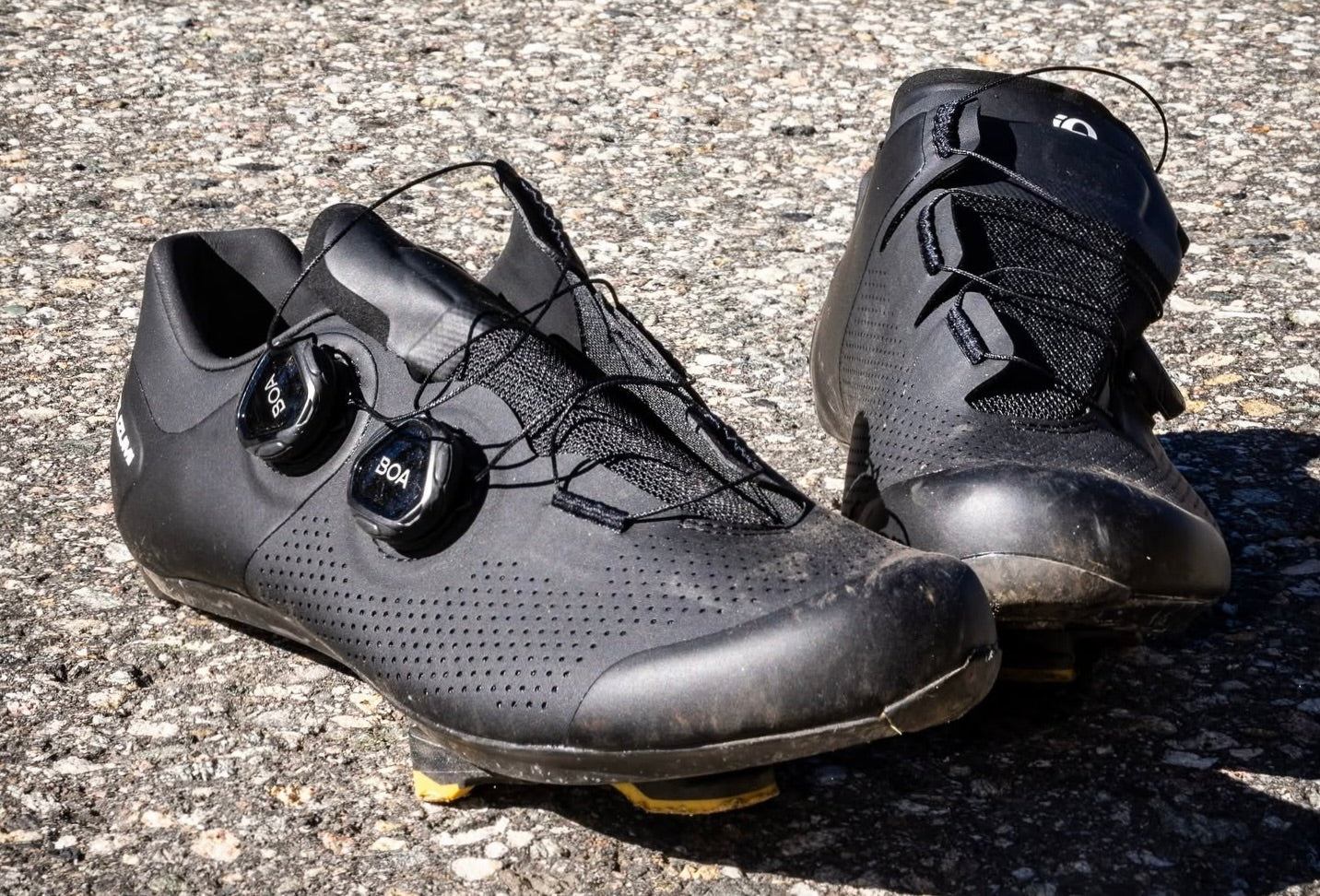
Mountain cleats are smaller and generally made of metal. They’re usually attached under the shoe with two bolts.
The Shimano SPD system is one of the most common, but there are also other systems such as Crankbrothers and TIME ATAC.
Mountain cleats are characterized by:
- their compact size;
- their resistance to wear;
- their ease of use in muddy conditions;
- their position often recessed between the shoe’s lugs;
- their versatility for mountain biking, gravel, and bikepacking/touring.
Because the cleat is usually recessed into the sole, the lugs touch the ground before the cleat. Walking is therefore easier and more natural than with road cleats.
Mountain clipless pedals also often allow you to clip in on both sides, which makes starts and remounting on the trail easier.
A two‑bolt pattern does not, however, guarantee compatibility with all mountain pedals. A Shimano SPD cleat will not necessarily work with a Crankbrothers or TIME ATAC pedal. You must always use the cleats designed for the pedal’s mechanism.

Platform pedals
Platform pedals don’t require any cleats or engagement mechanism. Your foot rests directly on a platform with pins that improve grip.
They’re especially popular with:
- beginner cyclists;
- urban cycling enthusiasts;
- recreational mountain bikers;
- some enduro and downhill riders;
- people who want to be able to unclip quickly.
Platform pedals let you put your foot down instantly and easily change its position on the pedal. They can also be used with many types of shoes, although a cycling shoe with a grippy sole generally provides better control.
Magnetic pedals
Magnetic pedals, such as Magped, are an in‑between solution between flat pedals and clipless pedals.
Instead of using a mechanism that locks a cleat into the pedal, they’re equipped with a magnet that attracts a metal plate installed under the shoe.
This system allows you to:
- better hold on the foot than with a flat pedal;
- to more easily find a stable position again;
- to unclip your foot in several directions;
- to avoid the precise release motion required by a clipless pedal;
- the option to choose different magnetic strengths depending on the model.
Magped pedals can be a good option for cyclists who want more support without feeling locked into the pedal. They can also be suitable for mountain biking, e‑bikes, and certain types of adaptive cycling.
It’s important to choose a model that’s compatible with your shoe’s mounting pattern, as well as a magnetic strength suited to your weight, your type of riding, and the level of retention you want.
Which pedal system should you choose?
The best system ultimately depends on your riding style and your preferences.
Choose road clipless pedals if:
- you ride mainly on pavement;
- you want a stable platform;
- you go on long rides;
- you don’t walk much in your cycling shoes.
Choose mountain bike clipless pedals if:
- you ride mountain bike or gravel;
- you sometimes need to walk;
- you want excellent retention in rough sections;
- you’re looking for a versatile clipless system.
Choose flat pedals if:
- you’re just getting into cycling;
- you want to be able to put your foot down immediately;
- you prefer to move your foot freely;
- you don’t want to use cleats.
Choose magnetic pedals if:
- you want more retention than with a flat pedal;
- you’re not comfortable with clipless pedals;
- you want to be able to unclip more easily;
- you’re looking for a versatile, in‑between solution.