




Hydraulic disc brakes on road bikes
The bike industry is constantly bringing new innovations to market. Some are more subtle, while others have a much bigger impact. For road bikes, hydraulic disc brake systems fall into the latter category.
Hydraulic disc brakes
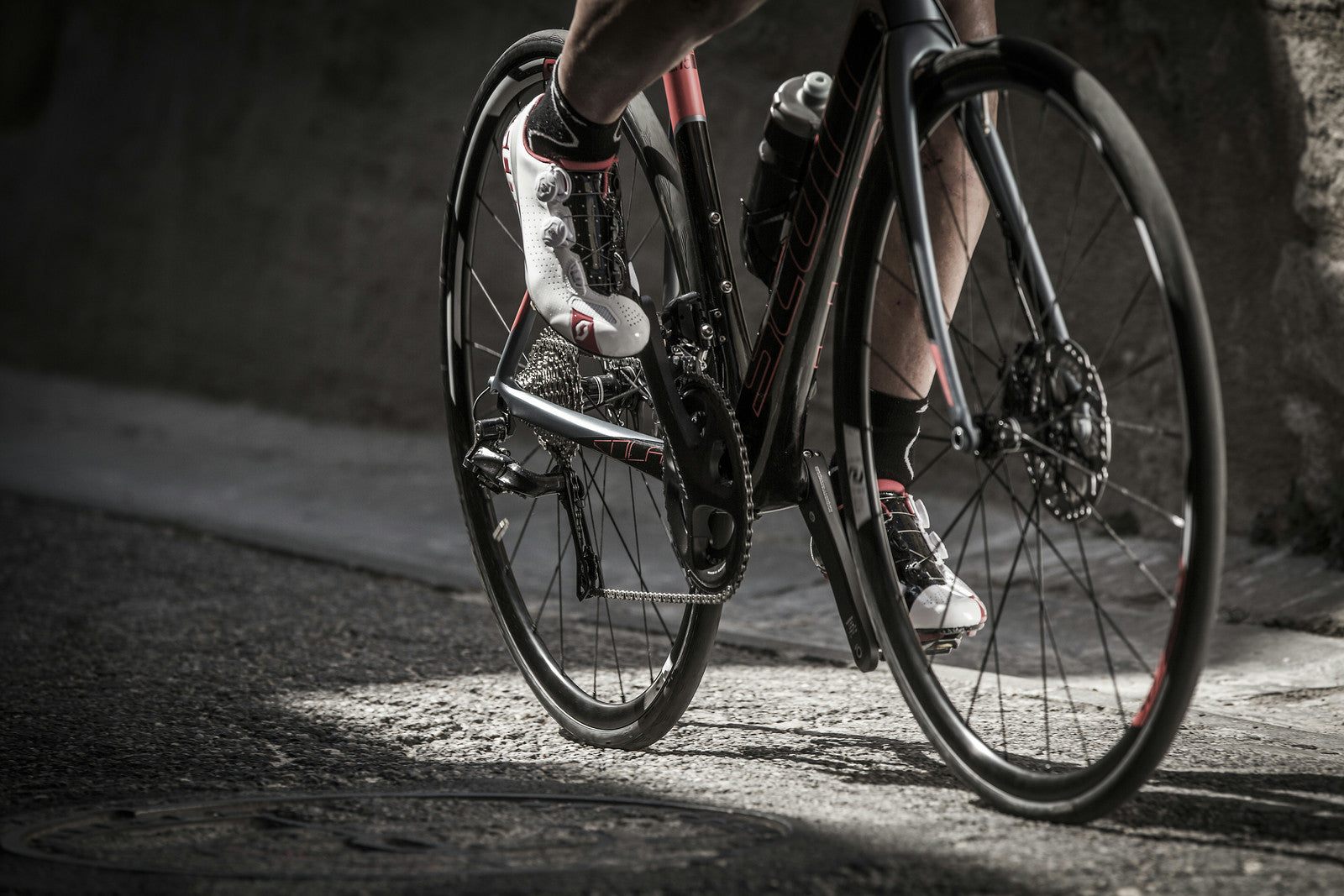
Disc brakes are often associated with mountain biking. However, there are several reasons why you might want them on a road bike as well. First, hydraulic disc brakes offer much more power than rim brakes. If you ride in hilly areas, you’ll notice the clear difference in braking power.
The most important aspect, however, isn’t raw power but the level of control that disc brakes provide. Some descents can end abruptly, and disc brakes give the rider better control all the way down, especially if you have to come to a complete stop at the bottom. Note that because the system is hydraulic, you don’t have to squeeze the levers hard, so your hands stay relaxed. No more having to work the brakes hard to get power—the hydraulic system does it for you!
Rim braking also imposes a compromise on the wheels. Currently, a wheel has to be stiff enough, aerodynamic, lightweight and… provide a braking surface! With carbon wheels becoming increasingly popular, it quickly became clear that braking was less powerful on these rims and that the material dissipated heat less effectively. Hydraulic disc brakes are therefore an innovation that comes at a perfect time, judging by the popularity of carbon wheels.
One of the most frequently asked questions is about the weight of disc brake systems. The truth is simple: disc brake systems are heavier. Another way to look at this issue is to ask whether disc brakes are *too* heavy.
| Weight in grams | Mechanical system | Disc brakes |
| Braking system | 835 | 1066 |
| Easton EC90 SL clincher | 1570 | 1610 |
| Total | 2405 | 2676 |
| Difference | 271 |
For a Shimano brake set and Easton EC90 SL wheels, the difference comes to 271 grams. If we add about 100 grams for the extra frame weight needed to mount disc brake calipers, the total difference comes to about three-quarters of a pound. You be the judge!
Maintenance is another issue people often wonder about. It’s true that hydraulic systems need to be bled annually to keep them working properly. That said, unlike cables, disc brakes don’t go out of adjustment as much. So the required maintenance is actually lower, apart from an annual fluid change and possibly new brake pads.
Disc brakes are here to stay; even the UCI (Union Cycliste Internationale) is expected to announce official support for disc brakes for racers. For everyone else, several road bike models equipped with disc brakes are already available in store. Follow us on Facebook to find out the dates of demo days to try disc brakes!

